

New Delhi.
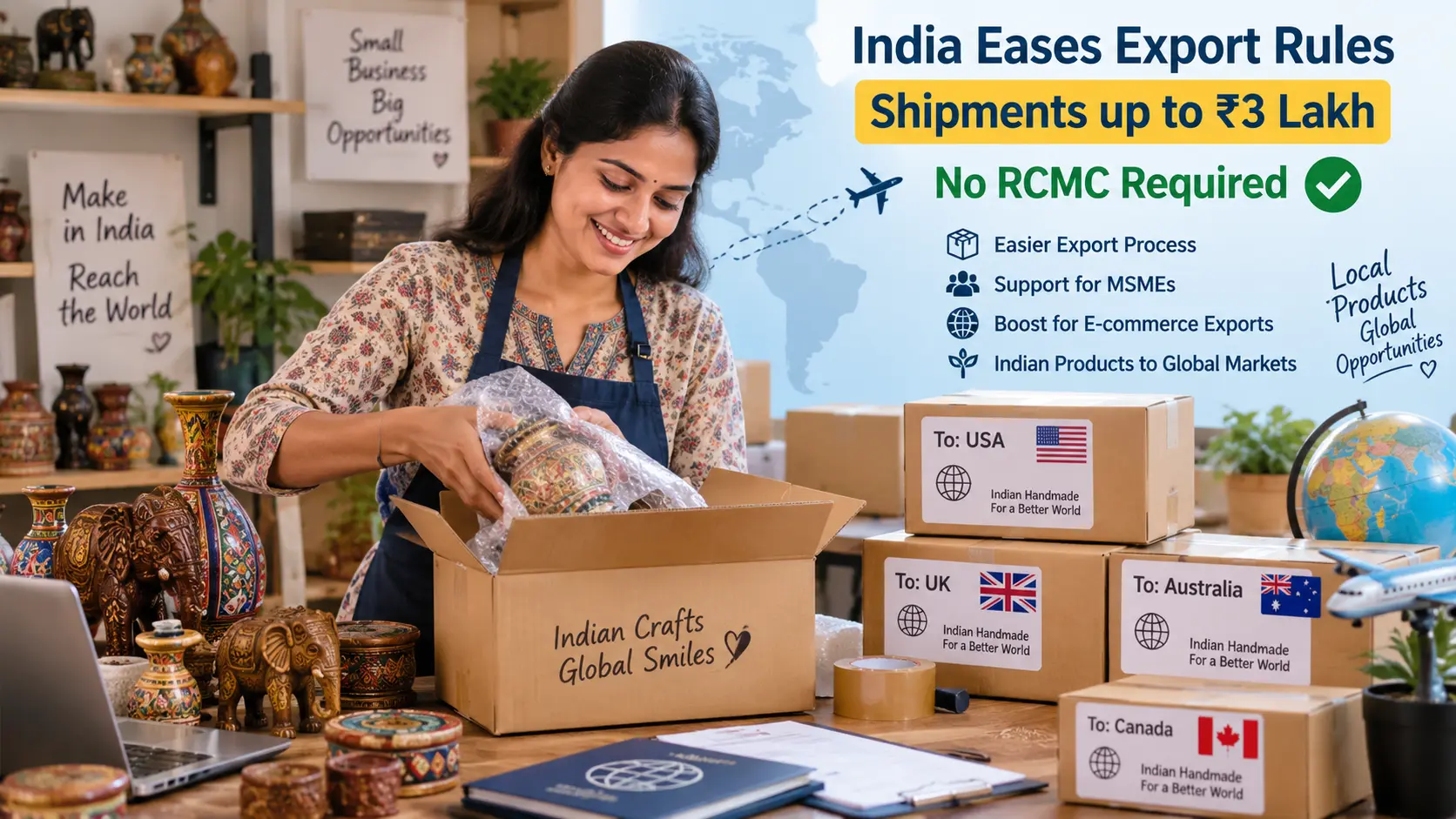
In a major policy move designed to empower micro, small, and medium enterprises (MSMEs), artisans, and direct-to-consumer (D2C) brands, the Government of India has significantly eased compliance friction for cross-border trade. Under the updated framework issued by the Directorate General of Foreign Trade (DGFT), export consignments with a Free-on-Board (FOB) value of up to ₹3,00,000 no longer require a Registration-cum-Membership Certificate (RCMC) or equivalent Certificate of Registration, even where otherwise prescribed under the Foreign Trade Policy (FTP) 2023.
This strategic de minimis relaxation targets lower-ticket shipments—particularly those dispatched via postal, courier, and emerging international e-commerce channels. By eliminating initial registration barriers for smaller orders, first-time entrepreneurs can now test overseas markets without navigating time-consuming bureaucratic onboarding.
For additional insights into national business updates and policy analyses, readers can refer to the comprehensive reporting at Matribhumi Samachar English.
What Has Changed?
The central amendment alters the regulatory baseline for low-value consignments:
-
Targeted Exemption: Export shipments with an FOB value of up to ₹3 lakh are exempt from mandatory RCMC or registration certification under Para 2.57 of FTP 2023.
-
Per-Consignment Threshold: The ₹3 lakh threshold applies individually to each eligible export consignment rather than capping annual turnover.
-
Continuation for High-Value Orders: Any export consignment exceeding ₹3,00,000 FOB must strictly comply with existing RCMC and EPC membership norms.
-
Channel Inclusive: Designed specifically to boost exports leaving India via foreign post offices, express courier terminals (CSB-V), and cross-border marketplace platforms.
Why Was This Relaxation Introduced?
Prior to this amendment, first-time exporters shipping low-value goods faced the same administrative hurdles as multi-crore trading houses. Getting an RCMC required identifying the correct Export Promotion Council (EPC) or Commodity Board, paying annual membership dues, and submitting extensive documentation prior to clearance.
This procedural burden created a friction point for small businesses testing international demand. By removing this hurdle for small-value consignments, the Ministry of Commerce & Industry aims to bring thousands of informal sellers, handicraft creators, and regional artisans directly into the global trade ecosystem.
Why Low-Value Shipments Carry Outsized Importance
While low-value shipments make up under 1% of India’s total merchandise export value, they represent over 40% of all shipping bills generated annually. Streamlining this high-volume, low-value category eliminates procedural backlogs without sacrificing standard customs tracking or security controls.
Traditional Process:   Market Identification ➔ EPC Membership (RCMC) ➔ Documentation ➔ First Export
New Small-Value Path: Market Identification ➔ Direct Shipping Bill (<= ₹3 Lakh FOB) ➔ Instant Export
Impact on MSMEs, Artisans & E-Commerce Sellers
This reform provides direct operational advantages across key sectors:
| Sector / Persona | Primary Impact |
| D2C & E-Commerce Brands | Seamlessly fulfill single orders from overseas retail buyers via courier without filing council paperwork. |
| Artisans & Craftsmen | Export traditional textiles, jewelry, and handicrafts directly to foreign shoppers. |
| Early-Stage Exporters | Conduct low-cost market testing in multiple countries before committing capital to full corporate registration. |
| Micro-Manufacturers | Ship product samples and low-volume pilot batches friction-free. |
What Happens When Your Business Scales?
This policy acts as an entry ramp rather than a permanent replacement for export registrations. Once an order surpasses the ₹3 lakh FOB value, standard Foreign Trade Policy guidelines apply:
-
Mandatory RCMC: Exporters must obtain a valid certificate from the relevant EPC (e.g., FIEO, CLE, TEXPROCIL, APEDA) to process consignments above ₹3 lakh.
-
Accessing Schemes: Claiming full benefits under government schemes—such as Duty Drawback or RoDTEP on larger commercial consignments—still necessitates formal EPC registration.
Frequently Asked Questions (FAQ)
Q1: Do I still need an Importer Exporter Code (IEC) for exports under ₹3 lakh?
Yes. The relaxation applies specifically to the RCMC certificate. An active Importer Exporter Code (IEC) remains a mandatory baseline requirement for all commercial exports from India regardless of consignment value.
Q2: Is the ₹3 lakh limit calculated per month, per year, or per shipment?
The ₹3 lakh FOB threshold is evaluated strictly on a per-consignment basis. You can send multiple shipments under ₹3 lakh throughout the year without requiring an RCMC for those specific orders.
Q3: Can I ship goods without an RCMC using international postal or courier services?
Yes. Courier Shipping Bills (CSB-V) and postal export channels fully support this RCMC waiver for shipments within the ₹3 lakh limit.
Q4: What should I do if my shipment value is ₹3,50,000?
Since the consignment value exceeds ₹3 lakh FOB, you must obtain a valid RCMC or Certificate of Registration from the designated Export Promotion Council or Commodity Board before exporting.
Disclaimer
This article is provided for informational purposes only based on official Foreign Trade Policy updates and notifications published by the Directorate General of Foreign Trade (DGFT), Ministry of Commerce & Industry, Government of India. Export rules, tax implications, and customs clearance requirements may vary depending on the specific tariff code (HSN), destination country, and nature of goods. Exporters are advised to consult official DGFT notifications or a qualified customs broker prior to dispatching consignments.