
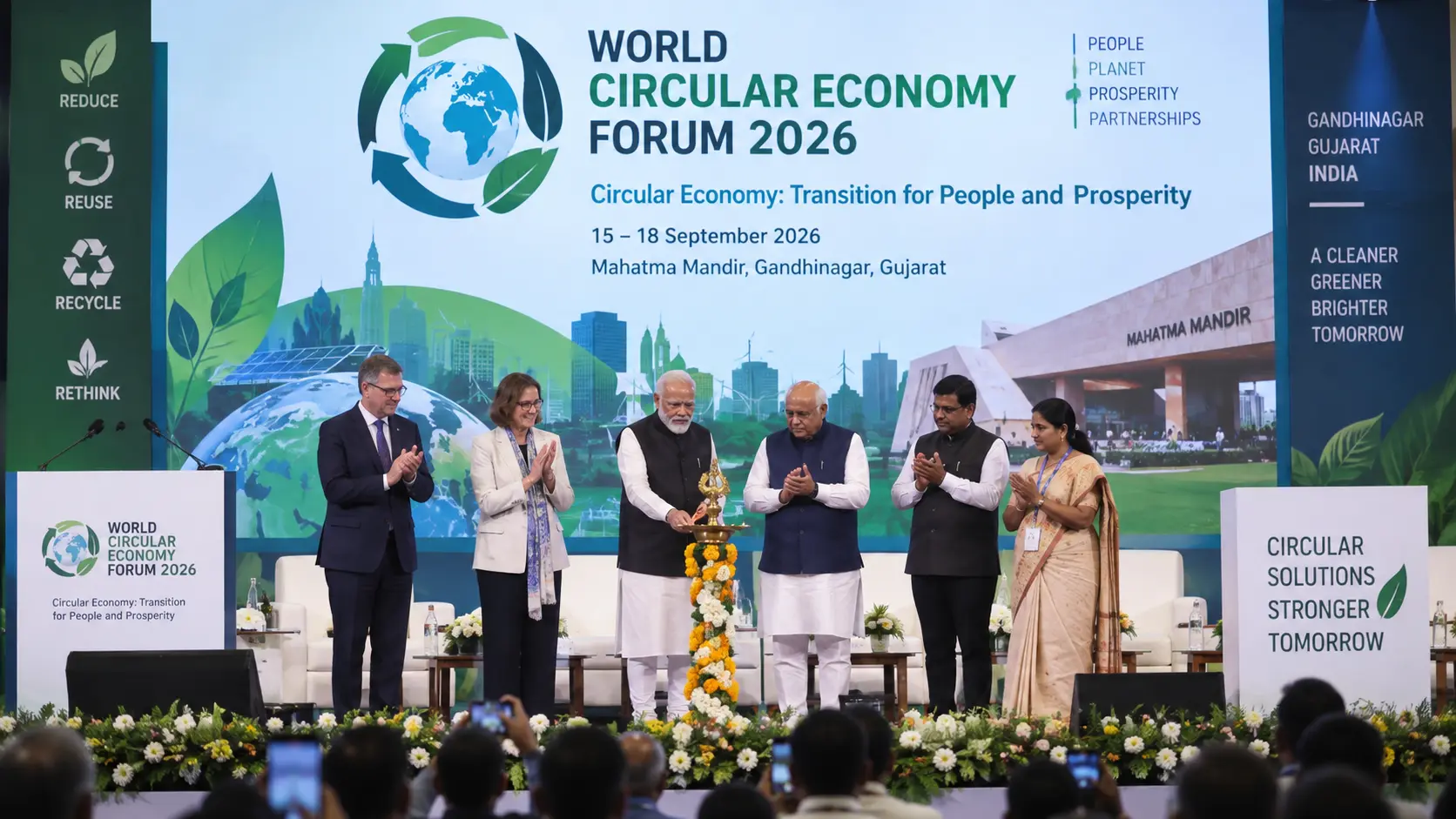
Gandhinagar | 15 September 2026
The World Circular Economy Forum (WCEF) 2026 officially kicked off today at the Mahatma Mandir Convention Centre in Gandhinagar, Gujarat. Marking the first time South Asia has hosted this prestigious global platform, the landmark event is jointly organized by India’s Ministry of Environment, Forest and Climate Change (MoEF&CC), the Central Pollution Control Board (CPCB), and the Finnish Innovation Fund (Sitra).
Held under the central theme “Circular Economy: Transition for People and Prosperity,” WCEF 2026 brings together over 2,000 global policymakers, corporate leaders, investors, researchers, and green innovators from more than 65 countries. The objective: redefine how modern economies handle consumption, cut industrial waste, and unlock domestic growth.
Understanding the Shift: Linear vs. Circular Economy
For decades, industrial economies have operated on a traditional linear model: “Take raw materials, make products, use them, and dispose of the waste.”
A circular economy replaces this wasteful pattern with a closed-loop framework designed to keep products, materials, and components in circulation for as long as possible.
Traditional Linear Model:   [ Extract Raw Materials ] ➔ [ Manufacture ] ➔ [ Consume ] ➔ [ Landfill Disposal ]
Circular Economy Model:     [ Sustainable Design ] ➔ [ Reuse & Repair ] ➔ [ Remanufacture ] ➔
[ Recycle & Recover ]
The circular model relies on six fundamental mechanisms:
-
Reduce: Minimizing raw material usage at the source.
-
Redesign: Engineering modular products for easy disassembly, longevity, and repair.
-
Reuse: Refurbishing secondary components to extend operational lifecycles.
-
Recycle: Processing end-of-life materials into high-grade secondary inputs.
-
Recover: Capturing bio-energy and valuable trace materials from industrial waste streams.
-
Closed-Loop Logistics: Optimizing supply chains to minimize material loss.
India’s 11 Strategic Sector Opportunities
Driven by rapid urbanization, manufacturing growth, and rising domestic consumption, India faces expanding waste streams that offer enormous secondary market potential:
-
Clean Mobility & Renewables: Used Lithium-ion batteries, solar panels, and end-of-life vehicles (ELVs).
-
Industrial & Technology: E-waste, scrap metals, industrial slag, municipal solid waste, and used oil.
-
Consumer & Agricultural: Single-use plastics, worn tyres, and agricultural crop residue.
By capturing valuable trace elements—such as cobalt, lithium, copper, and rare earths—from waste streams, India can lower its dependence on raw material imports while safeguarding national resource security.
MSMEs and Social Integration: The Engine of Transition
Small and medium-sized enterprises (MSMEs) form the backbone of India’s processing, repair, and logistical networks. Supporting MSMEs with green financing, modern technology transfers, and streamlined infrastructure will accelerate cleaner manufacturing.
Equally vital is the formalization of India’s informal waste sector. Millions of informal waste pickers and sorters currently handle the bulk of municipal recycling. Integrating these workers into organized, safe, and fair-wage municipal recycling systems enhances collection rates while delivering social justice.
Execution Roadmap: What India Must Do Next
To convert circular policies into industrial achievements, India must prioritize seven actionable objectives:
-
Source Segregation: Mandatory waste sorting at household and commercial collection hubs.
-
Modern Infrastructure: High-efficiency Material Recovery Facilities (MRFs) across tier-1, tier-2, and industrial hubs.
-
Stable Markets: Quality standards and public procurement mandates for recycled content.
-
Circular Design Rules: Incentives for manufacturers to produce repairable, durable goods.
-
Targeted Green Finance: Capital access tailored for circular startups and MSMEs.
-
Strict EPR Enforcement: Uniform compliance under Extended Producer Responsibility guidelines.
-
Worker Protection: Health benefits, safety protocols, and formal training for waste sector workers.
Frequently Asked Questions (FAQ)
Q1: What is the main objective of WCEF 2026 in Gandhinagar?
A: WCEF 2026 aims to accelerate global cross-sectoral collaboration, showcasing how moving from a linear to a circular economy drives economic growth, creates jobs, and secures critical material supply chains.
Q2: How does a circular economy help Indian MSMEs?
A: It opens new business opportunities in eco-friendly manufacturing, material recovery, component refurbishment, specialized recycling, and supply chain logistics.
Q3: What role does Extended Producer Responsibility (EPR) play in circularity?
A: EPR mandates force manufacturers to take financial and operational responsibility for the post-consumer collection, recycling, and safe disposal of their products.
Related Coverage & Publications
-
For further analysis on environmental policies, sustainable economy initiatives, and national updates, visit the official publication archives on Matribhumi Samachar.
Disclaimer
This article is published for educational and informational purposes only. Information regarding event schedules, policy frameworks, and market projections is compiled from official summit updates and government press releases.