
Mumbai. 15 September 2026
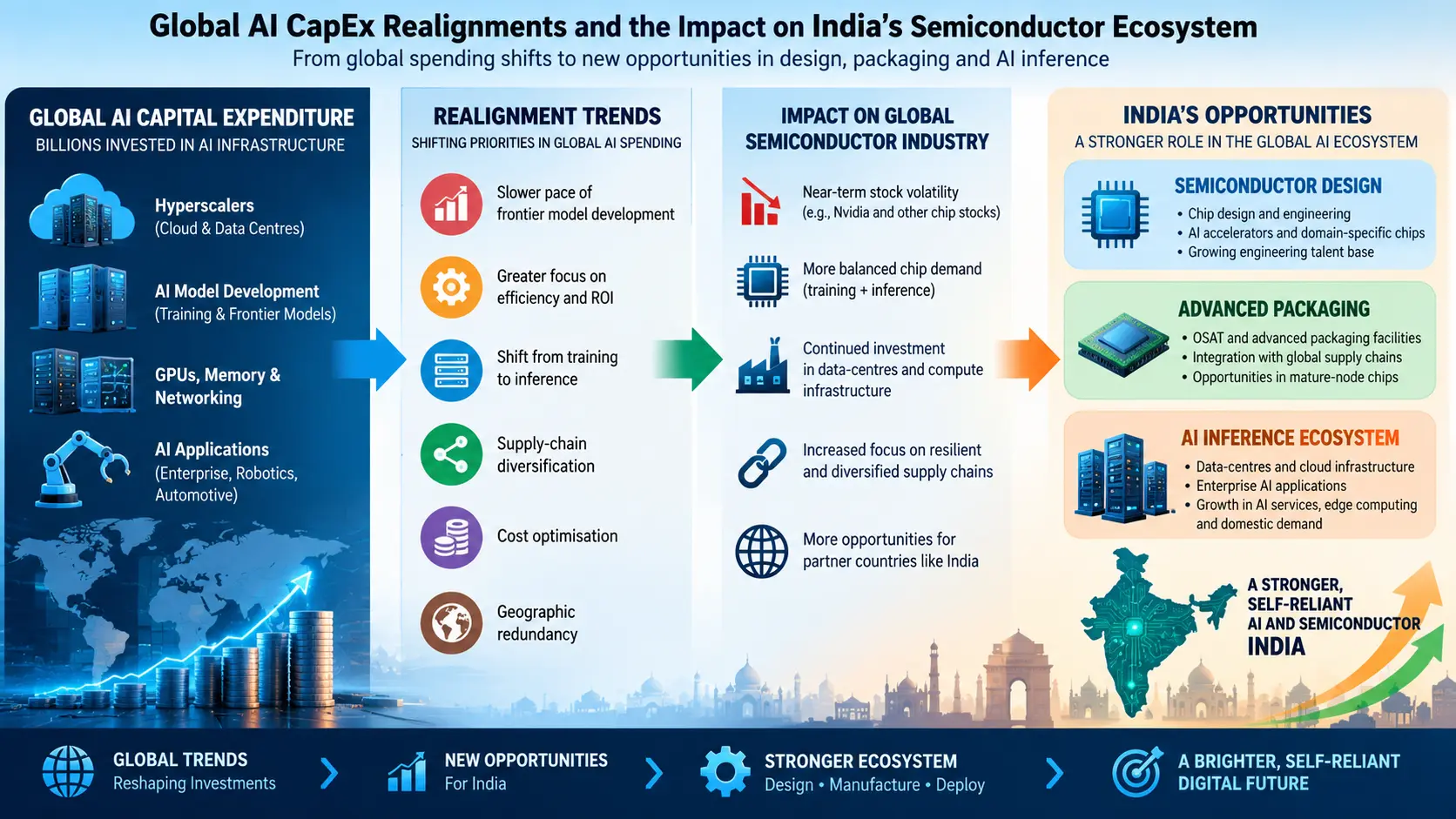
The global artificial intelligence boom is undergoing a strategic recalibration. Market turbulence and valuation pressures on semiconductor heavyweights such as Nvidia, Micron, and Advanced Micro Devices (AMD) have raised fundamental questions across global capital markets: Can the historic pace of data center, graphics processing unit (GPU), high-bandwidth memory (HBM), and networking hardware spending be sustained?
For India, the short-term macro volatility brings both nuance and structural insulation. While a prolonged global capital expenditure (CapEx) correction poses cyclical risks, it also opens key tactical windows for India’s growing semiconductor design, advanced packaging, and sovereign AI infrastructure.
┌────────────────────────────────────────────────────────────────────────┐
│               Global Frontier AI Capex Re-evaluation                    │
│     (Valuation pressures, AI training-to-inference operational shift)   │
└───────────────────────────────────┬────────────────────────────────────┘
                                    │
                  ┌─────────────────┴─────────────────┐
                  ▼                                   ▼
┌───────────────────────────────────┐   ┌───────────────────────────────────┐
│     Global Foundry Challenges     │   │     India Ecosystem Realignment   │
│ • GPU & HBM inventory re-pricing  │   │ • OSAT / Advanced Packaging push  │
│ • Wafer supply chain adjustments  │   │ • Focus on custom chip design     │
│ • CoWoS packaging bottlenecks     │   │ • Localized AI inference & models │
└───────────────────────────────────┘   └───────────────────────────────────┘
Why Semiconductor Leaders Face Valuation Scrutiny
The central question driving equity market re-evaluations is straightforward: If frontier AI developers slow down the cadence of new model releases, will hyperscalers scale back their chip orders and data center expansions?
However, industry data reveals a critical distinction between model training cycles and operational computing demands:
-
The Shift from Training to Inference: As AI deployment matures, computing workload requirements migrate from training foundational models toward AI inference—the real-time execution of AI agents, enterprise automation, robotics, and localized consumer applications.
-
Persistent Compute Demand: Enterprise adoption and public-sector integrations require massive base compute capacity, ensuring baseline hardware utilization even if frontier model iteration slows down.
-
Supply Chain Bottlenecks: Growth limits in recent quarters have often stemmed from advanced packaging constraints (such as Chip-on-Wafer-on-Substrate or CoWoS) rather than an immediate collapse in enterprise end-demand.
Strategic Implications for India’s Semiconductor Ecosystem
Unlike legacy hardware manufacturing hubs, India’s semiconductor foundation is anchored in high-density engineering, chip design, and microelectronics software.
+-------------------------------------------------------------------------+
|                    INDIA AI & SEMICONDUCTOR LAYERS                      |
+--------------------------+----------------------------------------------+
| LAYER                    | DOMESTIC OPPORTUNITY & FOCUS                 |
+--------------------------+----------------------------------------------+
| AI Models                | Indian-language & domain-specific LMMs/SLMs  |
| AI Applications          | Healthcare, fintech, agritech, governance    |
| Chip Design              | Custom ASICs, RISC-V architectures, SoC      |
| Packaging (OSAT/ATMP)    | Advanced packaging & testing infrastructure  |
| Mature-Node Fabs         | Power electronics, automotive, IoT chips     |
| Talent Pool              | Deep-tech hardware & embedded software talent|
+--------------------------+----------------------------------------------+
1. Global Supply Chain Diversification
If global hyperscalers and fabless chip companies shift focus toward cost optimization and supply chain resilience, India becomes an ideal partner. Under the Semicon India Programme, approved projects across Gujarat, Assam, and Uttar Pradesh—focusing on Outsourced Semiconductor Assembly and Test (OSAT) and mature-node manufacturing—are positioned to absorb outsourced packaging and testing demand.
2. Multi-Layer AI Strategy
India’s IndiaAI Mission prioritizes localized compute capacity, public-sector AI prototypes, and indigenous foundational models. By prioritizing domain-specific applications in governance, agriculture, and healthcare over multi-billion-dollar frontier model races, domestic demand remains insulated from global chip market fluctuations.
Key Risk Factors & Market Catalysts
Potential Chain Reaction of a Prolonged Slowdown
A multi-quarter decline in global hardware CapEx presents tangible risks to new projects:
Lower AI CapEx → Reduced GPU/HBM Orders → Semiconductor Equipment Delays → Capital Constraints for New Fab Initiatives
For greenfield domestic facilities, lower global chip prices could extend breakeven timelines and affect project economics.
Core Metrics to Monitor
-
Hyperscaler Capital Commitments: Quarterly CapEx disclosures from cloud service providers (Microsoft, Alphabet, Amazon, Meta).
-
Data Center & Inference Revenues: The ratio of training hardware sales to inference enterprise deployments in chipmaker earnings reports.
-
Execution Milestones: Commercial wafer output and packaging yields at domestic OSAT facilities under India’s semiconductor initiatives.
Related Coverage & External Resources
-
Explore national tech coverage and regional operational updates via Matribhumi Samachar English.
Frequently Asked Questions (FAQ)
Q1: Does a global slowdown in AI infrastructure spending ruin India’s semiconductor plans?
No. India’s strategy relies heavily on chip design, microelectronics engineering, OSAT/advanced packaging, and mature-node manufacturing (for auto and industrial chips), which are less exposed to frontier GPU CapEx cycles.
Q2: How does the transition from AI training to inference help the market?
Training requires intense, concentrated compute clusters. Inference occurs continuously as consumers and businesses interact with deployed AI tools, creating broader, steady long-term hardware demand.
Q3: What is the main focus of India’s domestic semiconductor initiatives?
Under policy programs like the India Semiconductor Mission, the country focuses on establishing domestic OSAT/ATMP facilities, supporting chip design startups, and securing fab projects to build a reliable supply chain.
Disclaimer
This article is for informational and educational purposes only and does not constitute financial, investment, or strategic corporate advice. Market conditions, project timelines, and economic projections are subject to change based on macroeconomic developments and official policy updates.