
Mumbai. 15 September 2026
India is preparing to overhaul its century-old legal framework governing financial records. Following presidential assent on August 13, 2026, the Ministry of Finance officially notified on September 10, 2026, that the Bankers’ Books Evidence Act, 2026 will come into force starting October 1, 2026.
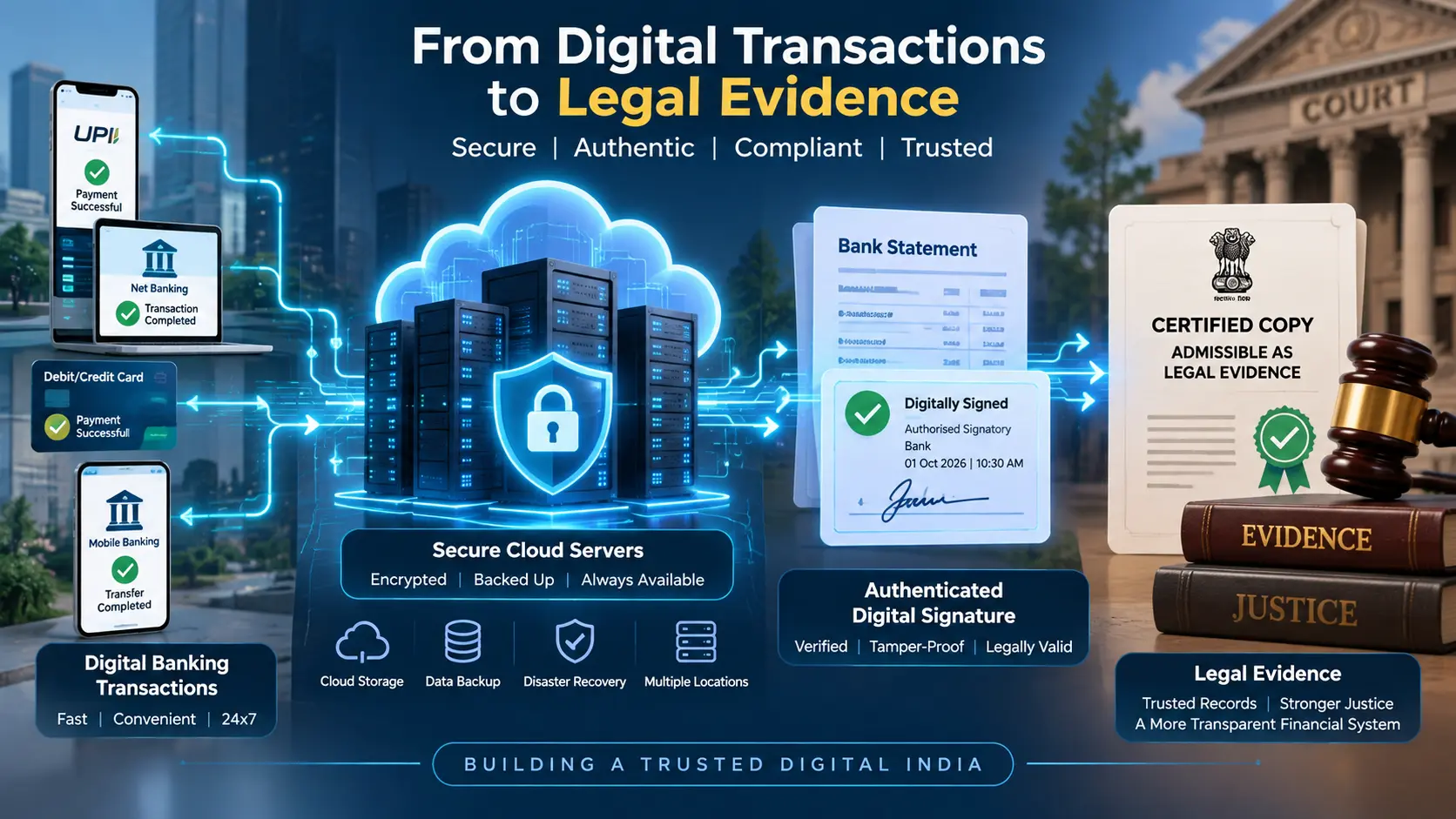
This statute repeals and replaces the British-era Bankers’ Books Evidence Act, 1891. It bridges a historical gap by aligning statutory evidentiary rules with contemporary fintech architectures—where transactions originate on mobile devices, process via core banking solutions (CBS), and reside within cloud computing infrastructure.
+-------------------------------------------------------------------------------------------------+
|                                 EVOLUTION OF BANKING EVIDENCE                                   |
+-------------------------------------------------------------------------------------------------+
|   1891 FRAMEWORK (Repealed)                   |    2026 FRAMEWORK (Effective Oct 1, 2026)      |
+-----------------------------------------------+-------------------------------------------------+
| • Centralized around physical paper ledgers   | • Technology-neutral, multi-format media        |
| • Severely limited cloud & digital relevance  | • Explicitly covers cloud, DR & offsite data    |
| • Traditional manual verification processes   | • Manual, digital, and electronic signatures    |
| • Bank officials frequently summoned by default| • Written "special cause" mandatory for summons |
+-------------------------------------------------------------------------------------------------+
Key Provisions of the Bankers’ Books Evidence Act, 2026
1. Technology-Neutral Definition of “Bankers’ Books”
The 2026 Act adopts an inclusive, technology-neutral definition. The statutory term “bankers’ books” now encompasses:
-
Electronic and digital logs generated across core banking channels.
-
Virtual database environments and multi-cloud platform storage.
-
Off-site servers, backup data centers, and Disaster Recovery (DR) facilities.
-
Contemporary data-storage mechanisms operating in real-time.
Under this legal framework, server location no longer dictates evidentiary value; system authorization and data integrity take precedence.
2. Certification Standards for Digital Admissibility
Digital bank statements do not gain automatic court admissibility. To qualify as a certified copy, an electronic record must meet strict statutory checks:
-
Multi-Mode Signatures: Certificates can be validated via manual, digital, or electronic signatures.
-
System Integrity Verification: Proof that systems operated without unauthorized disruption or system manipulation during data entry.
-
Cybersecurity Safeguards: Affirmation that protection mechanisms were active against unauthorized alteration or cyber threats.
3. Protection for Bank Officials Against Routine Summons
Under earlier practice, bank managers were regularly summoned to testify simply to authenticate routine ledger entries.
-
The 2026 Act mandates that when a bank is not a party to the suit, courts must record a “special cause” in writing before compelling a bank official to appear.
-
Statutory grounds for “special cause” include demonstrated doubts over record accuracy, severe system outages, or non-compliance with prior court directions.
Impact on Dispute Resolution
| Sector / User | Primary Practical Impact |
| Retail Customers | Streamlines evidentiary proof for disputed UPI/NEFT transfers, digital fraud claims, and personal loan recoveries. |
| Businesses & Enterprises | Reduces litigation lead-times in high-volume commercial arbitrations involving massive digital audit trails. |
| Financial Entities | Central Government holds powers to extend these evidence provisions to non-banking financial companies (NBFCs) and fintech entities. |
For more national business and legislative analysis, visit Matribhumi Samachar.
Frequently Asked Questions (FAQ)
What is the Bankers’ Books Evidence Act, 2026?
It is a modern Indian statute that replaces the colonial-era 1891 Act. It provides legal rules for admitting physical, digital, electronic, and cloud-based banking records as evidence in legal proceedings without needing original paper ledgers.
When does the Bankers’ Books Evidence Act, 2026 come into effect?
The Act officially comes into force on October 1, 2026, following notification by the Ministry of Finance on September 10, 2026.
Are digital bank statements automatically valid evidence in court?
No. Digital statements must be accompanied by a prescribed certificate verifying system integrity, lack of unauthorized tampering, and authentication via electronic, digital, or manual signature.
Does the Act cover records stored on cloud servers outside a bank branch?
Yes. The 2026 Act explicitly includes records stored on virtual platforms, offsite clouds, backups, and disaster-recovery sites.
Disclaimer
This article is published for informational and educational purposes only and does not constitute formal legal advice. Readers seeking guidance on specific court proceedings or evidence certification should consult a qualified legal professional.